In This Article
ToggleYou have found a plot you like. The size looks right, the location feels right, and you already have a rough picture of the house you want to build there. Maybe two bedrooms on the ground floor, a room upstairs for your parents, and a small terrace for evening tea. But one question decides whether that picture actually gets approved: how much are you allowed to build on this land?
Most buyers we meet in Indore know their plot size by heart, yet very few know the number that controls construction on it. That number is the floor space index, usually called FSI. It decides the total built-up area your plot can carry, and it quietly affects your building plan approval, your construction budget, and even the price you pay for the land.
FSI rarely comes up during site visits, and many families only hear about it when their architect redraws the plan because the first design crossed the limit. Knowing it before you pay a token amount saves you from that stress. So let us start with what FSI actually means and then move step by step to how it works on a real plot in Indore.
What is FSI in Real Estate? Meaning and Formula
When buyers ask us what is FSI, we explain it with one simple comparison. Floor space index is a ratio. It compares the total floor area of your building (all floors added together) with the area of your plot. The bigger this ratio, the more total construction the rules allow on the same piece of land.
FSI = Total floor area on all floors ÷ Plot area
Example: Plot size 1,000 sq ft + FSI 1.5 → You can build 1,500 sq ft in total
That 1,500 sq ft can be split in different ways:
- 750 sq ft + 750 sq ft → Ground floor + First floor
- 500 sq ft + 500 sq ft + 500 sq ft → Ground floor + Two upper floors
FSI fixes the total. How you divide it depends on other rules like ground coverage, setbacks and height. Think of it as a total budget of floor area. You can spend it on two large floors or three smaller ones, but you cannot go above the total.
This is also why a higher FSI does not automatically mean a taller house. If your road is narrow or the height limit for your area is low, you may not be able to use your full FSI by going up. In such cases, the plan has to balance floor size, number of floors and open spaces together, and your architect works out the layout that fits all these rules at once.
FSI vs FAR: Is There Any Difference?
FSI (Floor Space Index) and FAR (Floor Area Ratio) mean the same thing. Madhya Pradesh rules mostly use the word FAR, while buyers and brokers usually say FSI. Some papers also write it as a percentage:
- FSI 1.5 = FAR 1.5 = 150%
What is Included and Excluded in FSI Calculation?
| Usually Counted (+) | Usually Not Counted (−) |
| Bedrooms, hall, kitchen | Open terrace on top |
| Bathrooms and toilets | Parking provided as per rules |
| Enclosed balconies | Lift machine room and water tank area |
| Rooms on every floor | Certain open spaces allowed by rules |
The final list comes from the MP Bhumi Vikas Rules, and your architect checks it before submitting the building plan.
Who Decides FSI in Indore? Rules and Authorities
Many buyers assume the developer or the seller decides how much can be built on a plot. In reality, the number comes from government rules and the local planning bodies. FSI in Indore is set by these sources:
- MP Bhumi Vikas Rules, 2012: The main building rules for Madhya Pradesh. The official consolidated version is updated up to 6 March 2025 and covers FAR, ground coverage, setbacks, height, and parking. Every building plan in the state is checked against these rules, so this is the starting point for any FSI question.
- Indore Development Plan: Divides land into zones like residential, commercial, mixed-use, and agricultural. Your zone affects your FAR. Two plots in the same area can have different permissions if they fall in different zones on the plan.
- Indore Municipal Corporation (IMC): Gives building permission within city limits. If your plot is inside the municipal boundary, your building plan goes to IMC for approval.
- Indore Development Authority (IDA): Plans and regulates its own schemes. Plots in IDA schemes may also have scheme-specific conditions you need to follow.
- Town and Country Planning (T&CP): Approves layouts and confirms land use. This office tells you whether your plot is legally meant for residential construction in the first place.
Building plans in Madhya Pradesh are submitted online, and the system checks your FAR, coverage, and setbacks before approval. So a plan that crosses the limit simply does not pass. This is why it makes sense to know the permitted FSI in Indore for your exact plot before you finalize the design, not after.
FSI Calculation for Plot: Step-by-Step Formula
We usually tell buyers to do this small exercise before they shortlist any plot. FSI calculation for plot buyers takes just four steps, and you only need your registry papers and a basic calculator:
- Find your net plot area: Take the area in your registry and subtract any land reserved for road widening. FSI works on this net area, so if a part of your plot is marked for a future road, your buildable area comes down with it.
- Confirm the permitted FAR: For standard residential plots in Indore, base FAR is commonly around 1.25, but your zone and road width can change it. Ask the local authority or a registered architect for the exact figure instead of going by what a broker says.
- Multiply: Net plot area × FAR. The answer is the total floor area you can build across all floors.
- Check ground coverage and setbacks: These decide how big each floor can be. Ground coverage limits how much of the plot your ground floor can cover, while setbacks are the open spaces you must leave in front, at the sides, and at the back.
Once you have these four numbers, you get a clear idea of what your house can look like on paper. A proper FSI calculation for plot comparisons also helps you see why a slightly smaller plot on a better road can sometimes give you more usable area than a bigger one.
FSI Example for a 1,250 sq ft Plot in Indore
- Plot area → 1,250 sq ft
- FAR → 1.25
- Total buildable area → 1,250 × 1.25 = about 1,562 sq ft
Now, if ground coverage allows about 50% of the plot:
- Ground floor → about 625 sq ft
- First floor → about 625 sq ft
- Remaining area → about 312 sq ft for a partial second floor (like a study room with an open terrace)
Total → about 1,562 sq ft
Plot Size vs Buildable Area Table
The FAR values below are only for understanding. Always confirm the actual figure for your plot.
| Plot Size | Buildable Area at FAR 1.25 | Buildable Area at FAR 1.5 |
| 800 sq ft | 1,000 sq ft | 1,200 sq ft |
| 1,000 sq ft | 1,250 sq ft | 1,500 sq ft |
| 1,250 sq ft | 1,562 sq ft | 1,875 sq ft |
| 1,500 sq ft | 1,875 sq ft | 2,250 sq ft |
| 2,400 sq ft | 3,000 sq ft | 3,600 sq ft |
Doing this small FSI calculation for plot options before you pay a token amount helps you compare plots on what they can actually give you, not just their size.
Factors That Affect FSI on a Residential Plot
Your plot’s FSI does not depend on its size alone. These factors can push it up or bring it down:
| Factor | How It Affects Your FSI |
| Land use zone | Residential, commercial, and mixed-use zones get different FAR |
| Wider road in front | + Taller buildings and higher FAR allowed, mainly for bigger plots |
| Narrow road in front | − Lower height limit, usually ground plus two floors |
| Bigger plot size | #ERROR! |
| Road widening on plot | − Net plot area reduces, so total buildable area reduces |
| Premium FAR | + Extra FAR can be bought by paying a charge, within a set cap |
| TDR | + Development rights can be used to build above base FAR in notified areas |
Premium FAR and TDR: Can You Get Extra FSI in Madhya Pradesh?
Buyers often ask us if there is any legal way to build more than the base limit. Madhya Pradesh does offer two routes for this:
- Premium FAR: Madhya Pradesh allows extra FAR above the base on payment of a charge set by the state, within a limit. In simple words, you pay the authority for the additional floor area, and the extra area is approved along with your plan. The charge and the upper cap depend on the rules that apply to your plot.
- TDR (Transferable Development Rights): Under the MP TDR Rules, 2018, people who give land for public use (like road widening) get development rights. These can be used or sold to build more elsewhere. So the owner who loses land to a road gets a right that has value, and a builder in a notified area can buy that right to add more floor area. Indore has also moved to allow TDR on taller buildings across municipal limits.
Both routes are mostly used in larger projects such as apartments and commercial buildings, where extra floor area makes a real difference to the project’s numbers. For a regular independent house plot, these options rarely come into play, and the base FAR is usually what decides your plan.
How FSI Affects Plot Price and Resale Value
Two plots of the same size can have very different prices:
- Plot A → 1,500 sq ft, narrow lane, purely residential zone → Lower permitted construction
- Plot B → 1,500 sq ft, wide road, mixed-use zone → Higher permitted construction and more types of use
Same size, different potential → Different price.
Here is what FSI changes for you:
- + Rental income → An extra floor can be rented out later
- + Resale value → Buyers pay for what the land allows them to build
- + Family needs → Room to grow as your family grows
- − Lower FSI → Fewer options, even if the plot looks large
When you compare residential plots in Indore across growing areas like Super Corridor, Nipania and AB Bypass, look at road width, zone and layout approvals along with the price per sq ft.
Value is also not only about how much concrete a plot can hold. Many buyers now prefer plotted townships where open space is planned from the start.
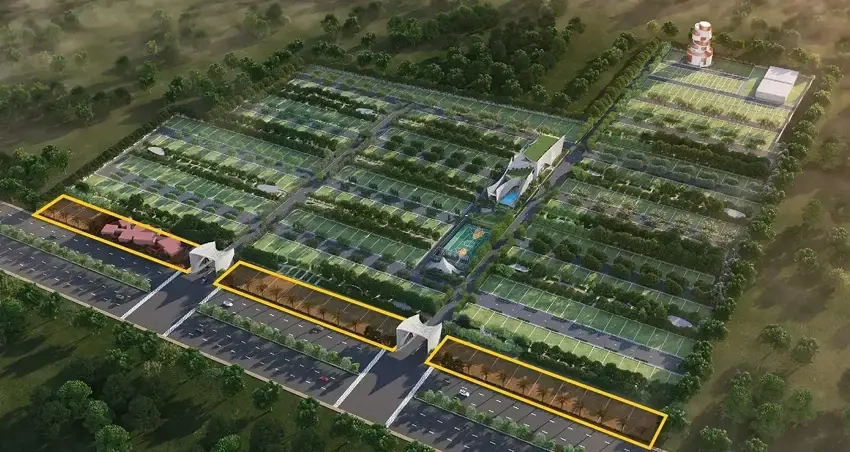
At Micro Mitti Madhuvan on AB Bypass, each 1,250 sq ft plot comes with a private backyard garden, and green spaces are planned across the township.
Common FSI Mistakes Plot Buyers Should Avoid
Most of the FSI problems we see do not come from complex rules. They come from small assumptions made during the buying stage. Here are the ones to watch for:
- Believing “you can build four floors here”: Unless it matches the FAR, height limit and road width, it is just a sales line. Ask for it in writing and verify it. A verbal promise does not carry any weight when your building plan is checked online.
- Forgetting setbacks and parking: Front, side, and back open spaces reduce your ground floor size. Parking rules can also take away space you planned for a room. Many buyers plan rooms based on the full plot size and later find that the actual floor is much smaller.
- Not checking land use: Some plots on city edges are still agricultural on paper. Building permission on such land works very differently, and a house plan meant for a residential plot may not get approval there.
If you are looking at land outside regular colonies, it helps to know how farmhouse land differs from villa plots legally.
- Skipping the ownership type: Check whether you are getting freehold or leasehold ownership, since leasehold terms can add conditions on construction. Some leases need permission from the lessor for additional floors, which can affect how much of your floor space index you can actually use.
How to Check Permitted FSI Before Buying a Plot
Before you pay any token amount, ask for these documents and verify them with the right office:
| Document | What It Tells You | Where to Get It |
| Land Use Certificate | Residential, commercial or agricultural | Town and Country Planning office |
| Approved Layout Plan | Plot size, road width, approval status | Seller, developer or T&CP |
| RERA Registration | Whether the project is registered | MP RERA website |
| Colony Development Permission | Whether the colony is legally developed | IMC or local body |
| Title Documents | Clear ownership | Seller, checked by a lawyer |
Simple checklist before you pay:
- Land use is residential
- Layout is approved
- Road width is confirmed
- Permitted FAR is known
- Architect has done a quick feasibility check
Once the plot clears these checks, the same documents come into use again during the plot registration process in Indore.
If you live outside India, a trusted local advisor matters even more. NRIs buying property from abroad usually depend on documents and representatives rather than office visits, so every number should be verified in writing.
Check Your Plot’s FSI Before You Buy
A plot is not just land. It is a promise of what you can build on it, and FSI is the fine print of that promise. Check it early, and you will avoid redrawn plans, rejected approvals, and costly surprises later.
Looking at residential plots in Indore and not sure what a plot can really give you? Share the plot details with our team.
We will help you read the FSI, check the papers, and understand the real building potential before you put down a single rupee.
Get Your Plot’s Building Potential Checked Free →
Prefer to see a planned township first? Book a Walkthrough at Madhuvan →
FAQs on FSI and Plots in Indore
Question: What is FSI in simple words?
Answer: FSI is the total floor area you can build on a plot, shown as a ratio of the plot size. FSI 1.25 on a 1,000 sq ft plot means 1,250 sq ft of total construction.
Question: What is the usual FSI in Indore for a house plot?
Answer: For standard residential plots, base FAR is commonly around 1.25. Larger plots on wider roads can get more. Confirm the exact FSI in Indore for your plot with IMC, IDA or T&CP.
Question: Is floor space index calculated on total or net plot area?
Answer: On net plot area, which is the area left after deductions like road widening.
Question: Can I build more than the allowed FSI?
Answer: Not without approval. Extra area is possible only through premium FAR or TDR where allowed. Construction beyond the approved limit can face action from the authority.
Question: How does FSI affect the price of residential plots in Indore?
Answer: Plots that allow more construction, because of a better road width or zone, usually cost more because they offer more building and rental potential.
Note: FSI rules can change through government amendments. Always confirm the latest permitted FAR for your plot with the local authority or a registered architect before planning construction.