In This Article
ToggleKey Highlights
- Gated township plots offer ready infrastructure, security, and RERA protection, ideal for investors and families.
- Open plots are cheaper to buy but require more legal homework, separate utility setup, and have slower resale.
- For long-term investment with lower risk, gated community plots in a growing city like Indore tend to appreciate more steadily.
- Your final choice depends on your goal: end-use living, pure investment, or construction flexibility.
Imagine this: You are sitting at your kitchen table on a Sunday afternoon. On one hand, you have a brochure for a gated township, green parks, smooth internal roads, and a clubhouse. On the other hand, you have a friend’s recommendation, a plain open plot near the bypass, at almost half the price.
Both seem like decent deals. But which one is actually better for you?
The gated township vs open plot debate is one of the most common dilemmas for Indian buyers in 2025-26, especially in fast-growing cities like Indore.
This blog breaks down the difference between gated townships and open plots in simple, clear language, no jargon, no confusion.
What is a gated township in Indore?
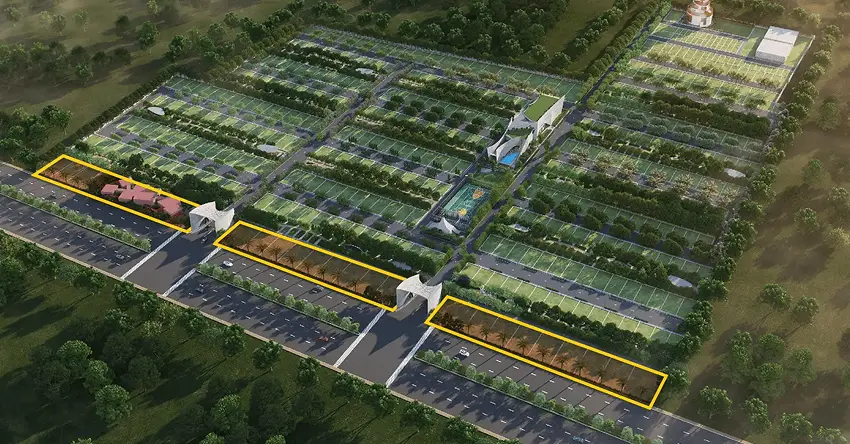
A gated township in Indore is a planned residential community inside a boundary wall, with a main entry gate, shared facilities, and a management structure run by the developer or a residents’ association.
Think of it as buying a plot inside a ready-made neighbourhood. You get:
- 24/7 security with guards, CCTV, and boom barriers at entry and exit points
- Internal roads, streetlights, and drainage, all pre-built and maintained
- Common areas like parks, a clubhouse, open gardens, and power backup
- RERA registration, legal protection for your money
Unlike a flat, a gated community plot gives you ownership of the land itself. You can build a home on your own schedule, within the township’s guidelines.
Micro Mitti Madhuvan in Indore is a real example. It is a RERA-approved (Reg. No.: P-OTH-25-5927) forest-concept gated township spread over 30 acres, designed by award-winning architect Sanjay Puri.
Plots start from 1,250 sq ft and come with private backyard gardens, a 35,000 sq ft central courtyard, clubhouse, and full infrastructure already in place. This is what a well-planned gated community plot looks like.
Before making your decision, take a virtual tour of Micro Mitti Madhuvan. Explore the township layout, green spaces, internal roads, clubhouse, amenities, and overall living environment designed for modern families.
What is an open plot or NA plot in Indore?
An open plot in Indore, also called a standalone plot or NA (non-agricultural) plot, is a single piece of land that is not part of any managed community. You buy it, and everything else is on you.
There are a few types:
- Residential plots: Already converted for residential use, with a clear sale deed.
- NA (non-agricultural) plots: Converted from farmland. Common in semi-urban and peripheral areas.
- Panchayat plots: Under the gram panchayat jurisdiction. Often cheaper, but legally more complex.
The title documents you will usually deal with include a sale deed, a 7/12 extract, or a patta certificate. Always verify these with a lawyer before buying.
The typical open plot investment buyer wants full control, to build when they want, design how they want, and at a lower upfront cost. But this freedom comes with more responsibility. That is the core of the open plot vs gated township comparison.
Gated township vs open plot: key differences
Factor | Gated Township Plot | Open / NA Plot |
|
Security |
24/7 guards, CCTV, boom barriers |
No shared security: buyer’s responsibility |
|
Amenities |
Clubhouse, parks, power backup, roads |
None, you arrange everything yourself |
|
Price per sq ft |
Higher (premium for facilities) |
Lower entry cost |
|
Maintenance Charges |
Monthly/annual fee applicable |
No ongoing society charges |
|
Resale Value |
Faster and better resale liquidity |
Slower resale, depends on location |
|
Legal Safety |
RERA registered, clear title |
Must verify independently (title, NA order) |
|
Construction Flexibility |
Subject to township bye-laws |
Full freedom to design and build |
|
ROI Timeline |
Steady appreciation over 5-10 years |
Can be faster in high-growth corridors |
|
RERA Compliance |
Mandatory for plotted townships |
Not always applicable |
|
Financing Ease |
Bank-approved loans available |
Loans harder to get for non-RERA plots |
ROI & appreciation: Which is a better investment?
Forget complicated formulas. Real estate returns really come down to one simple equation:
Real Plot Value = Location + Infrastructure + Liquidity − Risk
- Location decides how fast demand grows around your plot
- Infrastructure (roads, security, utilities) decides how livable and sellable it is
- Liquidity decides how quickly you can exit when you want to
- Risk (legal issues, delays, disputes) is what eats into your returns
Run this formula against both options, and the difference becomes clear:
- Gated township investment: Wins on infrastructure and liquidity. Appreciation is steadier because the location is already developed around you, not waiting to be developed.
- Open plot investment: Wins on entry price, but risk is higher. Returns depend heavily on whether your bet on the area pays off, and how long you are willing to wait.
- Rental income: Constructed homes in gated townships attract tenants faster. Open plots only start earning once you build.
For Indore specifically, the AB Road Bypass and ring road corridor, where Micro Mitti Madhuvan is located, are seeing real infrastructure movement: MR-11, MR-12, and the proposed RE-3 ring road.
That is the kind of groundwork that quietly drives gated township investment value upward over a 5-10 year horizon.
“Zameen khareedna sirf ek sauda nahi, yeh ek sapne ki neev hai.”
If you’re evaluating future growth corridors, explore our guide on Best Plot Investment Locations in Indore to compare appreciation trends across Super Corridor, AB Bypass, Nipania, and other emerging areas.
Legal safety: RERA, title deeds & due diligence
Legal clarity is where gated townships have a clear edge in the gated community plot vs open plot comparison.
For gated townships: Under RERA, plotted developments above a certain size must be registered with the government. The developer submits layout approvals, project timelines, and financial details. As a buyer, you are protected. If the developer delays or defaults, you have legal recourse.
For open plots: RERA may or may not apply. You are largely on your own when verifying the land. Common risks include:
- Disputed ownership or multiple claimants to the same title
- Land use conversion fraud: the plot may still be classified as agricultural
- Encumbrance, existing loans or claims against the property
- Missing NA conversion order or outdated documents
“Kanoon ki nazar mein jo zameen saaf hai, wahi asli daulat hai.”
Besides location and appreciation potential, investors should also consider whether a plot is freehold or leasehold, since the ownership structure can influence long-term value and resale.
Lifestyle factor: amenities, community & daily life
Beyond investment returns, a plot also affects how you and your family will actually live. This is where the standalone plot vs gated community difference becomes very practical.
Life inside a gated township: You wake up to maintained green pathways. Your children play in a safe, enclosed park. Internal roads are smooth. Power backup is available. You know your neighbours through the clubhouse. Security checks every visitor at the gate. It feels calm and organised.
Life with an open plot: You have complete freedom. No maintenance fees, no society rules. You can build a home, a shop, or any configuration you like. But you also manage everything yourself — water connection, electricity, road access, and boundary security.
Who prefers what?
- Families with children: Usually prefer gated townships for safety, parks, and school proximity.
- Pure investors: Often comfortable with open plots if the location has strong appreciation potential.
- Retirees: Prefer gated communities for ease of maintenance and security.
- Self-construction buyers: Often prefer open plots for total design freedom and lower entry cost.
Still wondering whether land remains a smart asset class? Our analysis of plot investment opportunities in Indore for 2026 explores market demand, infrastructure growth, and long-term appreciation potential.
Cost comparison: what will you actually pay?
The price in the brochure is just the starting point.
Here is the full picture for a 1,000 sq ft plot in Indore as a practical residential plot buying guide:
Cost Head | Gated Township (1,000 sq ft) | Open Plot (1,000 sq ft) |
|
Base Price (Indore avg.) |
Rs. 40-60 lakh |
Rs. 15-30 lakh |
|
Legal / NA conversion charges |
Included / minimal |
Rs. 1-3 lakh |
|
Development charges |
Included in price |
Borne separately by the buyer |
|
Maintenance (annual) |
Rs. 20,000-50,000 |
Nil |
|
Utility connections |
Ready / included |
Rs. 2-5 lakh separately |
|
GST |
Applicable to under-construction |
Minimal/exempt |
|
Total estimated outgo |
Rs. 42-65 lakh (all-in) |
Rs. 18-38 lakh + construction |
Disclaimer: Prices are approximate based on Indore market data for 2025-26. Actual costs vary by location and developer.
The gap narrows once you add up what a gated township already includes: roads, utilities, and legal clearances that cost extra on an open plot. The best plot investment option isn’t the cheapest one; it’s the one that gives you the most value for the risk.
You can also compare some of the most sought-after investment corridors in our roundup of top residential plot investment destinations in Indore.
Which one is right for you? A buyer’s decision guide
Here is a simple way to decide:
Choose a gated township plot if you want:
- Ready infrastructure, roads, utilities, amenities, without any effort from your side
- Safety and security for your family from day one
- Predictable investment with RERA protection and bank loan eligibility
- A property that is easy to sell or refinance in the future
- To invest in Indore without worrying about daily management or legal paperwork
Choose an open plot if you want:
- Full freedom to design and build on your own timeline
- A lower upfront investment with no maintenance fees
- To hold land for 10-15 years in a high-growth area
- Commercial development or mixed-use construction flexibility
- No society obligations or construction guidelines to follow
The open plot vs gated township decision comes down to one question: How much time, legal work, and management effort are you willing to handle yourself, and what do you want this land to eventually become?
Before making a final decision, it’s worth reviewing a detailed residential plot buying checklist covering legal verification, location analysis, infrastructure, and future development plans.
What real plot owners say: gated township vs open plot experiences
Sometimes the most honest answer comes from people who have already gone through it. Here is what real buyers say:
★★★★★”Security and maintained roads made all the difference. I looked at open plots on the same road — cheaper, yes, but the roads were broken and there was no clear boundary. The township gave me peace of mind from day one.”— Rahul M., Indore | Gated Township Buyer |
★★★★”I wanted full control over construction — open plan, no society rules. An NA plot worked perfectly for me. ROI in 4 years was solid because I bought early in an area that grew fast. But I spent a lot on legal verification before buying.”— Sunita K., Bhopal | Open Plot Investor |
You can also hear directly from homeowners and families who have chosen Micro Mitti Madhuvan and discover what makes gated township living different from a traditional open plot investment.
Final thoughts
Both gated townships and open plots have a place in a smart real estate portfolio. Here is the short version:
- Want safety, infrastructure, and predictable returns with less effort → Go with a gated township plot
- Want maximum flexibility, lower entry cost, and full control over construction → Open plot can work — but do your legal homework thoroughly
- Want both, premium location, RERA approval, and a smarter entry point → Explore gated community plots in Indore through co-investment
The gated community plot vs open plot debate does not have one universal answer. But if you are buying in a fast-growing city like Indore, where ring roads, schools, hospitals, and malls are all coming up rapidly, a well-located gated township plot is generally the lower-risk, higher-confidence choice.
If you want to see what this looks like in practice, Micro Mitti Madhuvan is a good place to start, a RERA-approved gated township built on exactly this thinking.
Reach out through our Contact Us or call our team directly to plan a site visit.
“Sahi zameen, sahi waqt par — yahi asli nivesh hai.”
FAQs: gated township vs open plot
Question: Is a gated township plot better than an open plot for investment?
Answer: For most buyers, yes, especially in Tier 2 cities. Gated township plots typically offer RERA compliance, better infrastructure, stronger resale demand, and easier access to bank financing. Open plots can generate higher returns in select growth corridors, but they often involve greater legal due diligence and development risks.
Question: Are gated township plots RERA registered?
Answer: Most large plotted township developments are required to be registered under RERA. Buyers should always verify the project’s RERA registration number on the respective state RERA portal before investing. For example, Micro Mitti Madhuvan is registered under MP RERA (RERA No. P-OTH-25-5927).
Question: Can I get a home loan for an open plot?
Answer: Obtaining finance for an open plot can be more challenging. Banks generally prefer RERA-approved projects with clear documentation. Gated township plots are usually easier to finance through major lenders such as HDFC Bank, ICICI Bank, and SBI.
Question: Which is better for NRI investment, gated township plots or open plots?
Answer: Gated township plots are generally the preferred choice for NRIs. They offer professional maintenance, transparent documentation, RERA protection, and better long-term asset management, making ownership and monitoring easier from overseas.